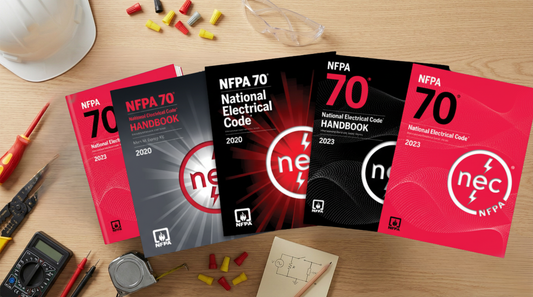

Electrical Code Books Collection: What Each Book Is Used For
If you’ve ever searched “electrical code book” and got buried under NEC editions, handbooks, state amendments, and exam prep guides—you’re not alone. The truth is: most people buy the wrong book (or buy too many) because they don’t know what each one is meant to do.
Here’s a practical breakdown of the most common electrical code books and exactly when each one is useful.
1) NEC (National Electrical Code) — The main rulebook
Used for: Installing and inspecting electrical systems safely and legally (where adopted).
Who needs it: Electricians, contractors, inspectors, engineers, serious students.
This is the core code text. It’s not “study notes.” It’s the actual rules. If your work touches wiring, panels, grounding, or load calculations, this is the reference that matters.
Pro tip: You don’t “read” the NEC cover-to-cover. You learn to navigate it: Articles, Tables, Informational Notes, Annexes, and Index.
2) NEC Handbook — The “why” behind the rules
Used for: Understanding code intent, examples, and commentary.
Who needs it: Students, new electricians, anyone tired of guessing what the code means.
The Handbook typically adds explanations and diagrams that make the NEC less painful. If you’re learning, it often saves hours of confusion.
3) NFPA 70E — Electrical safety at work
Used for: Arc flash safety, PPE requirements, safe work practices.
Who needs it: Industrial electricians, facility teams, safety officers, maintenance supervisors.
NEC is about installation. NFPA 70E is about workplace safety while working on/near energized equipment.
If your environment is industrial or you’re doing maintenance and troubleshooting, this book is not optional—it’s the safety standard.
4) State/Local Amendments — The rules that override the NEC
Used for: Meeting the legal code in your region.
Who needs it: Anyone pulling permits or doing inspected work.
Many locations adopt the NEC with changes. If you ignore amendments, you can pass NEC rules and still fail inspection.
5) Code Calculations Guides — Fast reference for common math
Used for: Load calcs, conductor sizing, conduit fill, voltage drop.
Who needs it: Apprentices, exam takers, field electricians.
These aren’t replacements for the NEC. They’re “shortcut guides” that help you apply the rules quicker—especially under time pressure.
6) NEC Tabs / Index Guides — Speed, not knowledge
Used for: Finding sections fast during open-book exams and field reference.
Who needs it: Anyone taking a code-based test, and busy field techs.
Tabs won’t make you understand code. They will make you find answers faster, which is exactly what many exams reward.
7) Exam Prep Books (Journeyman/Master/Inspector)
Used for: Practice tests, timed drills, and code-navigation skills.
Who needs it: Anyone preparing for licensing or promotion.
Good exam prep books teach the real skill: locating code answers quickly and avoiding traps in question wording.
8) Illustrated / Wiring Books — Visual learning and best practices
Used for: Seeing common installations, diagrams, and typical layouts.
Who needs it: Beginners, DIY learners (where permitted), early apprentices.
These are great for understanding “what it looks like in real life,” but they’re not legal code authority.
What to Buy First (Simple Recommendations)
-
Student/apprentice: NEC + Tabs + a solid calculations guide
-
Field electrician: NEC + Tabs + state/local amendments
-
Industrial maintenance: NEC + NFPA 70E (and safety training)
-
Inspector: NEC + Handbook + amendments
FAQ
Is the NEC the same as local code?
Not always. Many areas adopt NEC with amendments—always check your local authority.
Do I need the newest edition?
Only if your exams/inspections require it. If your jurisdiction is on an older edition, buy that one.
Is a handbook enough without NEC?
No. Handbook is explanation; NEC is the actual code text.
Tags: